Artificial Intelligence is no longer a futuristic concept discussed only in tech conferences and innovation labs. In 2026, AI has become deeply integrated into everyday corporate operations across industries including finance, healthcare, marketing, logistics, HR, customer support, and software development. Companies worldwide are rapidly adopting AI-powered tools to improve efficiency, automate repetitive tasks, reduce operational costs, and increase productivity.
As a result, the corporate workforce is undergoing one of the biggest transformations in modern history. While AI is creating new opportunities, it is also changing the types of skills employers expect from professionals. Employees who adapt quickly to these changes are positioning themselves for long-term career growth, while those resistant to change risk falling behind in an increasingly competitive job market.
In this article, we explore how AI is reshaping corporate jobs and the essential skills employees need to stay relevant and successful in 2026.
The Rise of AI in Corporate Workplaces
Businesses are no longer asking whether they should adopt AI — they are now focused on how quickly they can integrate it into their workflows. AI-powered systems are helping organizations automate repetitive tasks such as data entry, customer interactions, scheduling, reporting, and even decision-making processes.
From AI chatbots handling customer service inquiries to machine learning systems predicting business trends, companies are leveraging technology at an unprecedented scale. Major enterprises are also using generative AI tools for content creation, coding assistance, sales forecasting, recruitment screening, and project management.
This rapid transformation is redefining traditional job roles. Employees are increasingly expected to work alongside AI systems rather than compete against them.
Why Traditional Skills Alone Are No Longer Enough
For decades, technical expertise and domain knowledge were sufficient for career stability. However, AI automation is changing that equation. Many repetitive and rule-based tasks are now being handled more efficiently by machines.
For example:
- AI tools can generate reports within seconds.
- Automated systems can analyze massive datasets faster than human analysts.
- Virtual assistants can handle administrative work with minimal human intervention.
As automation takes over routine tasks, employers are placing greater emphasis on uniquely human abilities such as creativity, strategic thinking, emotional intelligence, and adaptability.
In 2026, the most valuable professionals are not those who avoid AI, but those who know how to use AI effectively to enhance their productivity.
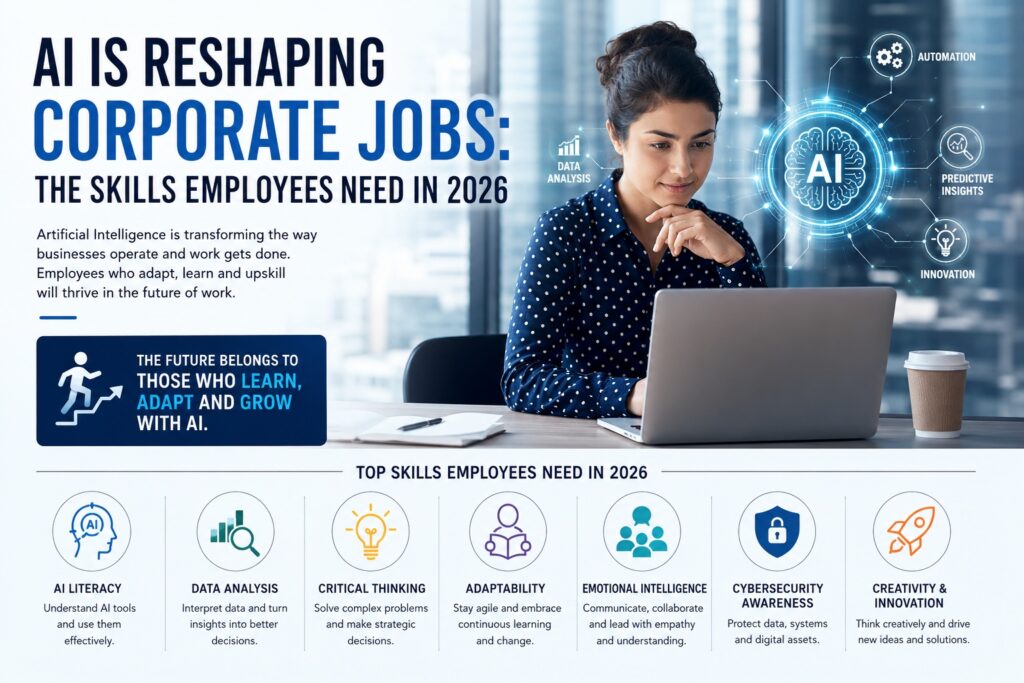
Top Skills Employees Need in 2026
1. AI Literacy
AI literacy has become as important as computer literacy once was. Employees do not necessarily need to become AI engineers, but they must understand how AI tools work, their limitations, and how to use them responsibly.
Professionals are now expected to:
- Use AI productivity tools efficiently
- Write effective prompts for generative AI systems
- Interpret AI-generated insights
- Verify AI outputs for accuracy and bias
Employees who understand AI fundamentals are becoming highly valuable across departments including marketing, HR, finance, operations, and customer support.
2. Data Analysis and Interpretation
Data has become the foundation of modern business decision-making. AI systems generate enormous amounts of information, but organizations still need humans who can interpret and apply those insights strategically.
Professionals with skills in:
- Data visualization
- Business intelligence
- Analytics platforms
- Performance reporting
are increasingly in demand.
Even non-technical roles now require basic data literacy. Understanding trends, metrics, and customer behavior gives employees a significant advantage in AI-driven workplaces.
3. Critical Thinking and Problem Solving
AI can process information quickly, but human judgment remains essential for solving complex business challenges. Companies are actively seeking employees who can evaluate situations, make strategic decisions, and think beyond automated recommendations.
Critical thinking skills help professionals:
- Identify flaws in AI-generated outputs
- Make ethical decisions
- Solve unexpected business problems
- Develop innovative strategies
As AI handles routine operations, human employees are focusing more on high-level decision-making and creative problem-solving.
4. Adaptability and Continuous Learning
The pace of technological change is faster than ever before. New AI tools, platforms, and workflows are emerging constantly, making adaptability one of the most important skills in 2026.
Employees who embrace lifelong learning are better prepared for changing job requirements. Companies are prioritizing candidates who demonstrate:
- Curiosity
- Learning agility
- Flexibility
- Openness to new technologies
Professionals who continuously upgrade their skills through online courses, certifications, workshops, and practical experience are more likely to thrive in modern corporate environments.
5. Emotional Intelligence and Communication
Interestingly, as workplaces become more automated, human-centered skills are becoming even more valuable.
AI cannot fully replicate:
- Empathy
- Leadership
- Relationship-building
- Team collaboration
- Conflict resolution
Strong communication and emotional intelligence are essential for managing teams, building client relationships, and leading organizations through digital transformation.
Managers and leaders who combine technical understanding with people skills are becoming critical assets for companies navigating AI adoption.
6. Cybersecurity Awareness
As businesses rely more heavily on AI and digital infrastructure, cybersecurity risks are increasing rapidly. Employees at all levels must understand basic cybersecurity practices to protect sensitive company data.
Important cybersecurity skills include:
- Identifying phishing attacks
- Managing secure passwords
- Understanding data privacy regulations
- Using secure collaboration tools
Cybersecurity awareness is no longer limited to IT departments — it is now a core workplace competency.
7. Creativity and Innovation
While AI can generate content and automate processes, true innovation still relies heavily on human creativity. Organizations are looking for employees who can develop fresh ideas, improve customer experiences, and create innovative business strategies.
Creative thinking helps businesses:
- Differentiate themselves from competitors
- Build stronger brands
- Improve products and services
- Adapt to changing market demands
Employees who can combine creativity with AI tools are becoming highly sought-after professionals.
Industries Experiencing the Biggest AI Transformation
AI is affecting nearly every corporate sector, but some industries are experiencing especially rapid change.
Technology
Software development, cloud computing, cybersecurity, and AI engineering roles are expanding rapidly.
Finance
Banks and financial firms are using AI for fraud detection, risk analysis, automated trading, and customer support.
Human Resources
Recruitment automation, AI-driven hiring platforms, and employee analytics are transforming HR departments.
Marketing
AI-generated content, predictive analytics, and personalized advertising are reshaping digital marketing strategies.
Healthcare
AI is improving diagnostics, patient care, and medical research while creating demand for tech-savvy healthcare professionals.
How Employees Can Future-Proof Their Careers
Professionals who want to remain competitive in 2026 should focus on building a balanced combination of technical and human skills.
Practical steps include:
- Learning AI tools relevant to their industry
- Taking online certifications in analytics or automation
- Developing communication and leadership abilities
- Staying updated on industry trends
- Building a strong digital presence on professional platforms
Networking, personal branding, and continuous learning are becoming just as important as formal qualifications.
Conclusion
AI is fundamentally transforming the corporate world, redefining job roles, workplace expectations, and career paths. While automation may replace certain repetitive tasks, it is also creating new opportunities for professionals who are willing to adapt and evolve.
The future workplace belongs to employees who can successfully combine human intelligence with artificial intelligence. Skills such as AI literacy, critical thinking, emotional intelligence, creativity, and adaptability are becoming essential for long-term career success.
In 2026 and beyond, the question is no longer whether AI will impact corporate jobs — it already has. The real challenge for employees is learning how to grow alongside it.