Artificial Intelligence is rapidly transforming modern workplaces, helping businesses automate tasks, improve productivity, and streamline operations. However, alongside official AI adoption, a new trend is quietly emerging across global corporations — “Shadow AI.”
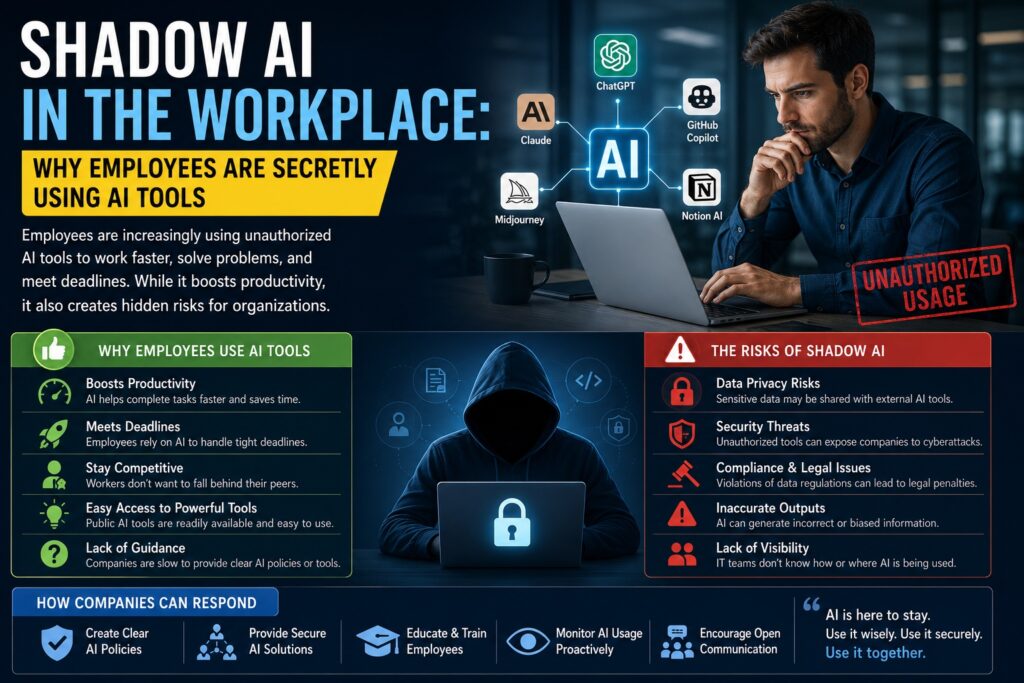
Shadow AI refers to employees using unauthorized AI tools, applications, or platforms without approval from their organization’s IT or management teams. From content generation and coding assistants to AI-powered analytics and automation tools, workers are increasingly turning to external AI solutions to complete tasks faster and more efficiently.
In 2026, Shadow AI has become one of the biggest challenges facing organizations worldwide. While employees see these tools as productivity enhancers, companies are becoming increasingly concerned about data privacy, cybersecurity, compliance risks, and uncontrolled AI usage.
This article explores why employees are secretly using AI tools, the risks and benefits of Shadow AI, and how organizations can respond effectively in the age of AI-driven work.
What Is Shadow AI?
Shadow AI is similar to the concept of “Shadow IT,” where employees use unauthorized software or systems without company approval. The difference is that Shadow AI specifically involves Artificial Intelligence tools being used independently by workers.
Examples of Shadow AI include:
- Employees using AI chatbots for work-related tasks
- Teams uploading sensitive company data into generative AI platforms
- Developers using unapproved AI coding assistants
- Marketing professionals generating content through external AI tools
- HR staff using AI for resume screening without official policies
In many cases, organizations are unaware of how frequently employees are interacting with AI systems during daily operations.
Why Employees Are Secretly Using AI Tools
1. Increased Productivity
The biggest reason employees use AI tools secretly is simple — AI helps them work faster.
AI platforms can:
- Write emails and reports within seconds
- Summarize documents instantly
- Generate code snippets
- Analyze data quickly
- Automate repetitive tasks
Workers under pressure to meet deadlines often turn to AI tools to improve efficiency and reduce workload.
For many professionals, AI has become a productivity shortcut that saves hours of manual work every week.
2. Companies Are Slow to Approve AI Solutions
Many organizations still lack clear AI policies or approved enterprise-grade AI platforms. While leadership teams debate compliance and governance issues, employees are already experimenting with public AI tools on their own.
This gap between corporate policies and employee behavior creates the perfect environment for Shadow AI to grow.
Workers often believe:
- Official tools are outdated
- Approval processes are too slow
- AI tools can improve performance immediately
As a result, employees bypass internal systems and adopt external AI platforms independently.
3. Competitive Workplace Pressure
Modern corporate environments are highly competitive. Employees are constantly expected to increase productivity, deliver faster results, and manage growing workloads.
AI tools provide a significant advantage by helping professionals:
- Finish tasks more quickly
- Improve content quality
- Automate repetitive work
- Handle multiple responsibilities simultaneously
Many workers fear falling behind colleagues who are already leveraging AI tools effectively.
This pressure encourages employees to secretly integrate AI into their workflows even without organizational approval.
4. Lack of AI Training and Governance
In many companies, employees receive little or no guidance about proper AI usage. Without clear policies, workers often make their own decisions regarding which tools are acceptable.
Common organizational problems include:
- No AI usage policies
- Limited AI education
- Poor communication from leadership
- Lack of enterprise AI solutions
When companies fail to provide secure AI alternatives, employees naturally seek external tools to meet their needs.
The Benefits of Shadow AI
Although organizations often view Shadow AI negatively, it is important to recognize that employees usually adopt these tools with positive intentions.
Improved Efficiency
AI can automate repetitive administrative work, allowing employees to focus on higher-value tasks.
Faster Innovation
Teams experimenting with AI often discover creative ways to improve workflows and productivity.
Enhanced Employee Performance
AI tools can assist with:
- Research
- Writing
- Data analysis
- Brainstorming
- Customer support
Employees using AI effectively may produce higher-quality work in less time.
Increased Job Satisfaction
Workers who automate repetitive tasks often experience reduced stress and greater job satisfaction.
The Risks of Shadow AI
Despite its benefits, Shadow AI introduces serious concerns for organizations.
1. Data Privacy Risks
One of the biggest dangers is employees uploading confidential company information into public AI platforms.
Sensitive data may include:
- Customer records
- Financial reports
- Internal strategies
- Proprietary code
- Employee information
If external AI systems store or process this data insecurely, organizations could face major privacy violations.
2. Cybersecurity Threats
Unauthorized AI applications can create security vulnerabilities within corporate networks.
Risks include:
- Malware exposure
- Data leaks
- Unauthorized API integrations
- Weak authentication practices
Cybercriminals are increasingly targeting AI systems and exploiting insecure AI workflows.
3. Compliance and Legal Issues
Many industries operate under strict data protection regulations.
Uncontrolled AI usage may violate:
- GDPR
- HIPAA
- Financial compliance regulations
- Intellectual property laws
Companies could face legal penalties if employees misuse AI systems without proper oversight.
4. Inaccurate or Biased AI Outputs
AI tools are not always reliable. Employees relying too heavily on AI-generated content may unintentionally spread misinformation or make flawed business decisions.
Potential problems include:
- Incorrect analytics
- Biased hiring recommendations
- Poor customer responses
- Factually inaccurate reports
Human review remains essential when using AI-generated outputs.
How Companies Are Responding to Shadow AI
Organizations are increasingly realizing that banning AI entirely is unrealistic. Instead, many businesses are shifting toward controlled AI adoption.
Creating AI Governance Policies
Companies are developing clear guidelines regarding:
- Approved AI tools
- Data protection rules
- Responsible AI usage
- Employee accountability
Well-defined policies help reduce confusion and misuse.
Providing Secure Enterprise AI Solutions
Businesses are investing in enterprise-grade AI platforms with stronger privacy and security controls.
These solutions allow employees to benefit from AI without exposing sensitive company data.
AI Training and Education
Organizations are now prioritizing AI literacy programs to teach employees:
- Safe AI practices
- Ethical AI usage
- Data privacy awareness
- Prompt engineering basics
Employee education is becoming a critical part of corporate AI strategy.
Monitoring and Risk Management
IT and cybersecurity teams are implementing monitoring systems to identify unauthorized AI usage and assess potential risks.
Many companies now treat AI governance as part of broader cybersecurity management.
The Future of AI in the Workplace
Shadow AI is likely to continue growing as AI tools become more accessible and powerful. In many ways, the rise of Shadow AI reflects a broader workplace reality: employees are eager to adopt technologies that improve efficiency and productivity.
Rather than resisting AI adoption, forward-thinking organizations are learning how to integrate AI responsibly while balancing innovation with security and compliance.
The companies that succeed in 2026 and beyond will be those that:
- Encourage responsible AI experimentation
- Provide secure AI infrastructure
- Train employees effectively
- Build transparent AI governance frameworks
Conclusion
Shadow AI is rapidly becoming one of the defining workplace trends of the modern corporate era. Employees are secretly using AI tools because they want to work smarter, faster, and more efficiently in increasingly demanding professional environments.
While Shadow AI introduces serious risks related to data privacy, cybersecurity, and compliance, it also highlights the growing importance of AI in everyday business operations.
Organizations that respond with education, secure AI systems, and clear governance policies will be better positioned to harness the benefits of AI while minimizing potential threats.
In 2026, the challenge is no longer stopping employees from using AI — it is learning how to manage AI adoption responsibly in the evolving digital workplace.