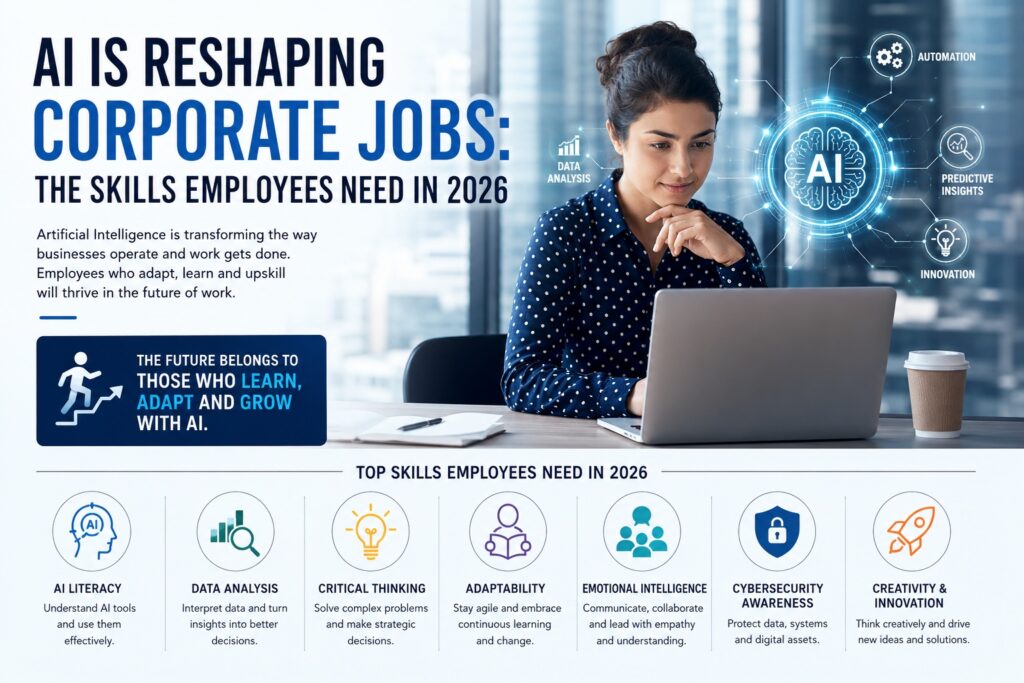
The job market is undergoing one of the biggest transformations in modern history. Artificial Intelligence is rapidly changing how businesses operate, automate tasks, and hire employees. In 2026, many traditional entry-level roles are evolving as companies increasingly adopt AI-powered systems to improve efficiency and reduce operational costs.
For graduates entering the workforce, this shift has created both uncertainty and opportunity. Many young professionals are worried that AI tools and automation may replace beginner-level jobs before they even start their careers. From customer support and administrative work to data processing and content creation, many routine tasks once assigned to junior employees are now being handled by intelligent systems.
However, the rise of AI does not mean the end of entry-level careers. Instead, it signals the beginning of a new employment landscape where adaptability, digital skills, and human-centered abilities are becoming more valuable than ever before.
In this article, we explore how entry-level jobs are changing in the AI era and how graduates can successfully build careers in the evolving digital economy.
How AI Is Changing Entry-Level Jobs
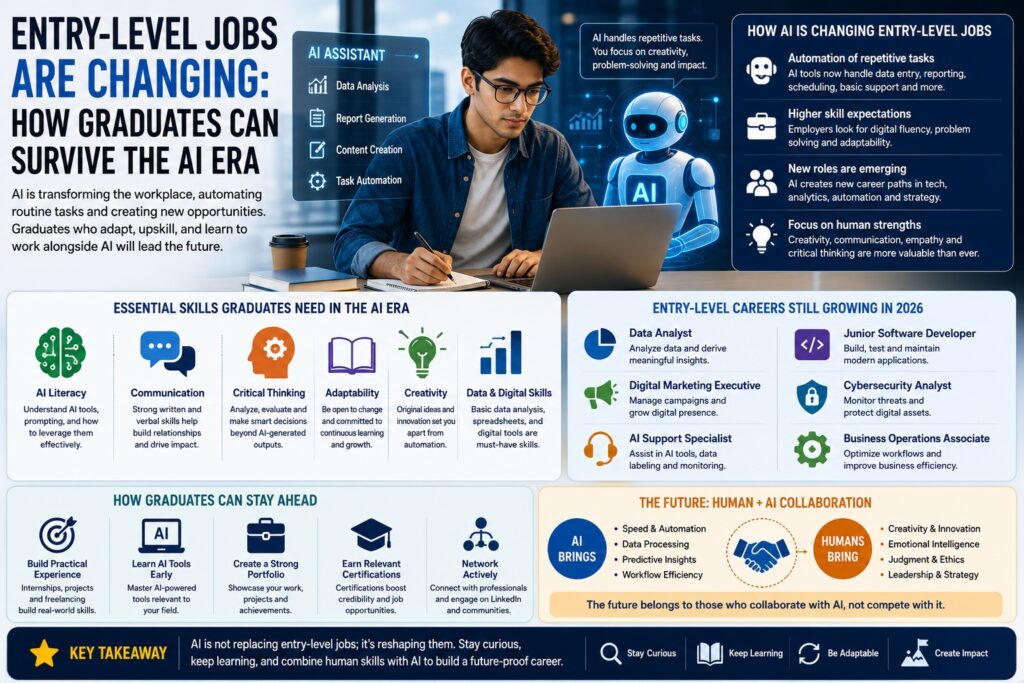
Artificial Intelligence is transforming workplaces by automating repetitive and rule-based tasks. Businesses are using AI systems to:
- Generate reports
- Analyze data
- Schedule meetings
- Handle customer inquiries
- Write basic content
- Process documents
- Screen resumes
As a result, some traditional entry-level responsibilities are disappearing or being reduced significantly.
For example:
- AI chatbots now handle many basic customer service tasks
- Automated software can process invoices and financial records
- Generative AI tools can draft emails, summaries, and reports
- AI recruitment systems can filter job applications automatically
This shift means graduates can no longer rely solely on basic administrative or repetitive skills to secure long-term career opportunities.
Why Graduates Are Concerned About AI
Many graduates entering the workforce feel uncertain about their future because AI adoption is accelerating rapidly.
Common concerns include:
- Fewer entry-level opportunities
- Increased competition
- Automation replacing beginner tasks
- Higher skill expectations from employers
- Lack of practical experience
In previous decades, entry-level jobs often provided employees with opportunities to learn through routine tasks. Today, AI is automating many of those functions, reducing traditional learning pathways within organizations.
This has created pressure for graduates to become job-ready much faster than before.
AI Is Creating New Opportunities Too
While AI is replacing certain repetitive tasks, it is also creating entirely new career opportunities.
Companies now need professionals who can:
- Work alongside AI systems
- Manage AI-powered tools
- Analyze AI-generated insights
- Automate workflows
- Understand AI ethics and governance
The future workforce will increasingly involve collaboration between humans and intelligent technologies.
Graduates who understand how to use AI effectively may actually gain a competitive advantage over peers who avoid learning these tools.
Skills Graduates Need to Survive the AI Era
1. AI Literacy
AI literacy has become one of the most important skills for modern professionals.
Graduates should understand:
- How AI tools work
- What AI can and cannot do
- How to use AI responsibly
- Basic prompt engineering
- AI productivity tools
Even non-technical roles now require some level of AI understanding.
Employees who can effectively use AI to improve productivity are becoming highly valuable across industries.
2. Communication Skills
As automation handles repetitive tasks, human communication skills are becoming more important.
Employers value graduates who can:
- Communicate clearly
- Collaborate with teams
- Present ideas confidently
- Build relationships
- Manage clients professionally
Strong communication skills remain difficult for AI to replicate.
Remote and hybrid work environments have also increased the importance of digital communication abilities.
3. Critical Thinking and Problem Solving
AI can generate information quickly, but human judgment remains essential.
Companies increasingly seek graduates who can:
- Analyze situations critically
- Solve complex problems
- Make informed decisions
- Evaluate AI-generated outputs
Critical thinking helps professionals add value beyond automated systems.
Graduates who develop strong analytical skills will remain highly competitive in the future workforce.
4. Adaptability and Continuous Learning
Technology is evolving rapidly, making adaptability essential for career survival.
Graduates must become comfortable with:
- Learning new tools
- Upskilling continuously
- Adapting to workplace changes
- Embracing emerging technologies
The most successful professionals in the AI era will likely be lifelong learners.
Continuous education is becoming more important than static academic qualifications alone.
5. Creativity and Innovation
AI can generate content and automate tasks, but human creativity remains uniquely valuable.
Employers are increasingly searching for graduates who can:
- Generate original ideas
- Improve customer experiences
- Develop innovative solutions
- Think creatively
Creativity is becoming one of the strongest protections against automation.
Industries such as marketing, design, branding, product development, and media still depend heavily on human imagination.
6. Data and Digital Skills
Modern businesses rely heavily on data and digital systems.
Graduates should develop skills in:
- Data analysis
- Spreadsheet tools
- AI-powered software
- Cloud collaboration platforms
- Digital productivity tools
Basic digital literacy is no longer optional in the modern workplace.
Even non-technical jobs increasingly require comfort with technology and analytics.
Entry-Level Careers Still Growing in 2026
Despite automation concerns, several entry-level career paths continue growing strongly.
Technology Roles
- Junior software developers
- AI support specialists
- Data analysts
- Cybersecurity assistants
Digital Marketing
- Social media specialists
- Content strategists
- SEO analysts
Healthcare
- Healthcare administration
- Medical technology support
- Patient coordination roles
Human Resources
- Recruitment coordinators
- Employee engagement assistants
Many of these roles now involve working alongside AI systems rather than competing against them.
How Graduates Can Become More Employable
Build Practical Experience
Companies increasingly value practical skills over theoretical knowledge alone.
Graduates should:
- Build portfolios
- Complete internships
- Work on real-world projects
- Contribute to open-source work
- Freelance when possible
Hands-on experience helps candidates stand out in competitive job markets.
Learn AI Tools Early
Graduates who learn AI tools before entering the workforce gain a significant advantage.
Useful AI-related skills include:
- Prompt engineering
- AI productivity software
- Automation tools
- AI-assisted research
- Content generation systems
Understanding AI workflows can improve efficiency and employability.
Develop a Strong Online Presence
Professional branding is becoming increasingly important.
Graduates should maintain:
- An updated LinkedIn profile
- Professional portfolios
- GitHub repositories (for tech roles)
- Personal websites
Recruiters increasingly search online for talent and practical evidence of skills.
Certifications Can Help
Industry certifications can strengthen resumes and demonstrate commitment to learning.
Popular areas include:
- AI fundamentals
- Cloud computing
- Cybersecurity
- Data analytics
- Digital marketing
Certifications help graduates remain competitive in evolving industries.
The Future Workplace Will Reward Human Skills
Although AI will continue automating repetitive tasks, many human abilities remain difficult to replace.
These include:
- Empathy
- Leadership
- Creativity
- Communication
- Strategic thinking
- Ethical judgment
Graduates who combine digital skills with strong human-centered abilities will likely thrive in future workplaces.
The most valuable employees in 2030 may not be those who compete with AI, but those who know how to collaborate with it effectively.
The Rise of Human-AI Collaboration
The future of work is increasingly based on Human-AI collaboration rather than replacement.
AI provides:
- Speed
- Automation
- Data analysis
- Workflow efficiency
Humans contribute:
- Creativity
- Emotional intelligence
- Decision-making
- Innovation
- Leadership
Companies are now building hybrid work environments where employees and AI systems work together to improve outcomes.
Graduates who embrace this partnership mindset will be better prepared for long-term career success.
Conclusion
Entry-level jobs are changing rapidly as Artificial Intelligence transforms modern workplaces. While some traditional beginner tasks are becoming automated, new opportunities are also emerging for graduates who adapt to evolving industry demands.
The key to surviving the AI era is not avoiding technology — it is learning how to work alongside it effectively.
Graduates who develop AI literacy, communication skills, creativity, adaptability, and practical experience will remain highly valuable in the future workforce.
In 2026 and beyond, success will belong to professionals who combine human strengths with digital intelligence in an increasingly AI-powered world.