Artificial Intelligence is no longer operating separately from human employees — it is now working alongside them. In 2026, global corporations are rapidly building Human-AI hybrid teams where employees collaborate directly with AI systems to improve productivity, decision-making, innovation, and operational efficiency.
Rather than replacing workers entirely, many businesses are discovering that the most effective approach is combining human creativity, emotional intelligence, and strategic thinking with the speed, automation, and analytical capabilities of AI.
This transformation is reshaping how organizations operate across industries including technology, finance, healthcare, marketing, manufacturing, customer service, and human resources.
As companies continue accelerating digital transformation, Human-AI collaboration is becoming one of the most important workplace trends shaping the future of corporate work.
In this article, we explore the rise of Human-AI hybrid teams, why companies are adopting this model, the benefits and challenges involved, and how employees can prepare for the future of AI-powered collaboration.
What Are Human-AI Hybrid Teams?
Human-AI hybrid teams are workplace environments where employees and Artificial Intelligence systems collaborate to complete tasks, solve problems, and improve business performance.
In these teams:
- AI handles repetitive, data-driven, and automated processes
- Humans focus on creativity, leadership, communication, strategy, and decision-making
The goal is not to replace human workers but to enhance their capabilities through intelligent technology.
Examples include:
- AI assistants helping customer support agents
- AI-powered analytics supporting business leaders
- Developers working with AI coding tools
- Marketing teams using generative AI for content creation
- HR professionals using AI recruitment systems
Human-AI collaboration is becoming increasingly common across modern enterprises.
Why Global Corporations Are Adopting Human-AI Hybrid Teams
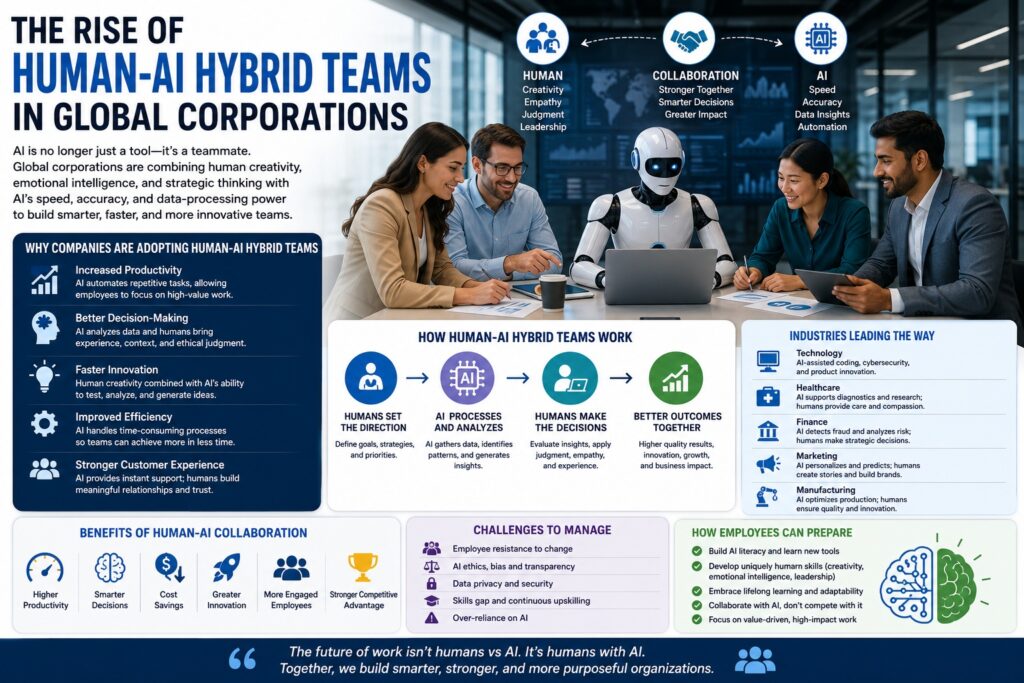
1. Increased Productivity
One of the biggest reasons companies are adopting hybrid teams is productivity improvement.
AI systems can:
- Process large amounts of data instantly
- Automate repetitive tasks
- Generate reports quickly
- Provide predictive insights
- Reduce manual workloads
This allows employees to spend more time on strategic and creative work.
For example:
- Customer service teams can resolve issues faster with AI assistance
- Analysts can interpret data more efficiently using AI tools
- Marketing professionals can generate campaign ideas rapidly
The combination of human expertise and AI efficiency creates significant productivity gains.
2. Better Decision-Making
AI systems excel at analyzing patterns, trends, and large datasets. However, human judgment remains essential for interpreting results and making business decisions.
Human-AI hybrid teams allow organizations to combine:
- AI-driven insights
- Human experience
- Strategic thinking
- Ethical judgment
This leads to more informed and balanced decision-making processes.
Executives increasingly rely on AI-powered analytics while still using human intuition to guide final business strategies.
3. Faster Innovation
AI is accelerating innovation across industries by helping teams:
- Test ideas quickly
- Analyze customer behavior
- Automate research
- Generate design concepts
- Improve product development
Human creativity combined with AI-powered experimentation allows organizations to innovate more rapidly than traditional business models.
Companies that successfully integrate AI into team workflows often gain a strong competitive advantage.
4. Improved Employee Efficiency
AI tools are helping employees reduce time spent on repetitive tasks such as:
- Scheduling
- Documentation
- Data entry
- Reporting
- Administrative work
As a result, workers can focus on:
- Leadership
- Relationship-building
- Strategic projects
- Problem-solving
- Innovation
Many organizations now view AI as a workplace assistant rather than a replacement for employees.
Industries Leading the Human-AI Hybrid Team Trend
Technology
Technology companies are leading AI integration by combining developers with AI coding assistants, analytics platforms, and automation systems.
Hybrid teams are improving:
- Software development
- Cybersecurity monitoring
- Cloud operations
- Product innovation
AI-assisted workflows are becoming standard in modern tech organizations.
Healthcare
Healthcare providers are using AI to support diagnostics, patient monitoring, and medical research.
Doctors and healthcare professionals work alongside AI systems to:
- Analyze medical scans
- Predict patient risks
- Improve treatment accuracy
However, human healthcare workers still provide emotional care, ethical decision-making, and patient communication.
Finance
Financial institutions are adopting Human-AI hybrid models for:
- Fraud detection
- Risk analysis
- Customer support
- Financial forecasting
AI helps process financial data quickly, while human experts make strategic investment and compliance decisions.
Marketing and Advertising
Marketing teams increasingly rely on AI tools for:
- Content generation
- Customer analytics
- Campaign optimization
- Personalization
Human marketers still guide branding, storytelling, emotional messaging, and creative direction.
The result is faster and more data-driven marketing strategies.
Human Skills Becoming More Valuable in the AI Era
As AI handles more technical and repetitive tasks, uniquely human abilities are becoming even more important.
Emotional Intelligence
Employees who understand emotions, relationships, and communication remain essential for leadership and teamwork.
Creativity
Human imagination and originality continue driving innovation and brand identity.
Critical Thinking
AI can provide data, but humans are still responsible for evaluating risks, ethics, and business impact.
Leadership
Organizations need leaders who can manage both human employees and AI-powered systems effectively.
The future workforce increasingly values human-centered skills alongside technical knowledge.
Challenges of Human-AI Hybrid Teams
While hybrid teams offer major benefits, they also create several challenges for organizations.
1. Employee Resistance
Some employees fear AI may eventually replace their jobs, creating anxiety and resistance to adoption.
Companies must address these concerns through:
- Transparent communication
- Training programs
- Upskilling opportunities
Organizations that support employees during AI transitions often achieve better results.
2. AI Governance and Ethics
AI systems can create issues related to:
- Bias
- Data privacy
- Security
- Compliance
- Transparency
Businesses need clear AI governance policies to ensure responsible and ethical AI usage.
3. Skills Gaps
Many employees still lack AI literacy and technical understanding.
Companies are increasingly investing in:
- AI education
- Digital skills training
- Internal learning programs
AI-ready workforces are becoming critical for long-term business success.
4. Overdependence on AI
Although AI is powerful, overreliance on automated systems can create problems if employees stop applying critical thinking and human judgment.
Organizations must maintain balance between automation and human oversight.
The Role of AI Assistants in Corporate Workplaces
AI assistants are becoming common members of corporate teams.
Employees now use AI tools for:
- Writing emails
- Generating reports
- Coding assistance
- Research
- Meeting summaries
- Workflow automation
AI assistants act as productivity enhancers rather than independent decision-makers.
This trend is expected to accelerate significantly through 2030.
How Employees Can Prepare for Human-AI Collaboration
Professionals who want to remain competitive should focus on developing both technical and human-centered skills.
Important areas include:
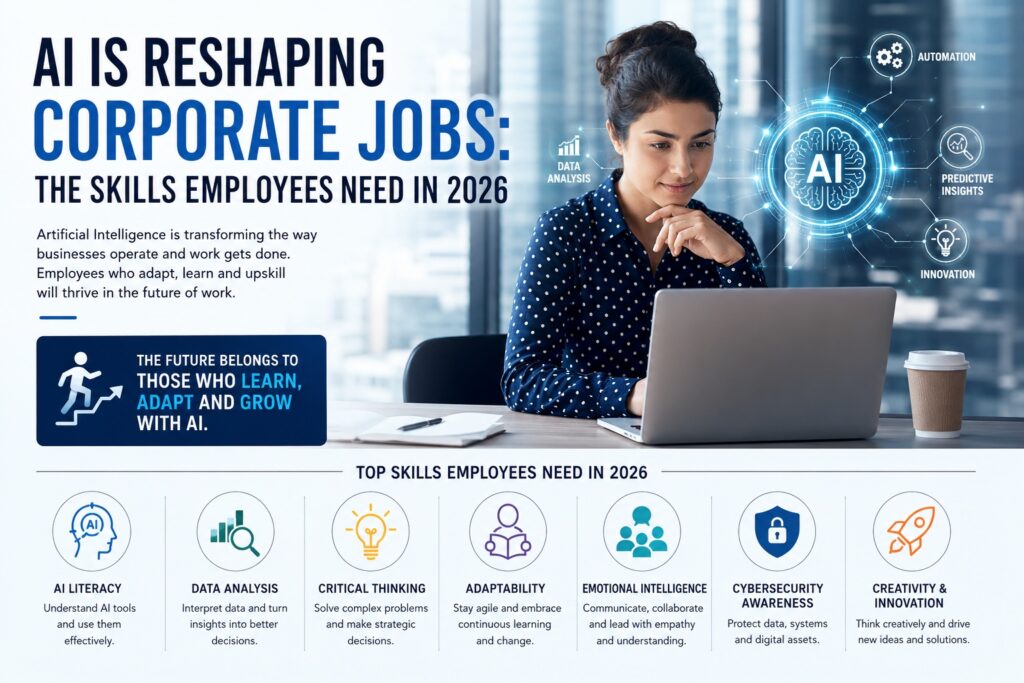
- AI literacy
- Data analysis
- Communication
- Creativity
- Problem-solving
- Adaptability
- Leadership
Employees who understand how to work effectively with AI tools will become highly valuable in modern organizations.
Continuous learning is becoming essential in the evolving workplace.
The Future of Work: Humans and AI Together
The future workplace is not likely to be fully automated. Instead, businesses are increasingly moving toward collaboration models where humans and AI systems complement each other’s strengths.
AI provides:
- Speed
- Automation
- Data processing
- Predictive insights
Humans contribute:
- Creativity
- Emotional intelligence
- Strategic thinking
- Ethical judgment
- Leadership
The combination creates stronger, smarter, and more efficient teams.
Companies that successfully balance human talent with AI capabilities are expected to lead the next era of global business innovation.
Conclusion
The rise of Human-AI hybrid teams is transforming the modern corporate world. Rather than replacing employees entirely, AI is becoming a collaborative workplace partner that enhances productivity, innovation, and decision-making.
Global corporations are increasingly realizing that the best results come from combining human strengths with AI-powered efficiency.
As AI adoption continues expanding, employees who embrace collaboration with intelligent technologies will remain highly competitive in the future workforce.
In 2026 and beyond, the most successful organizations will not be those powered only by AI — they will be those where humans and AI work together effectively.