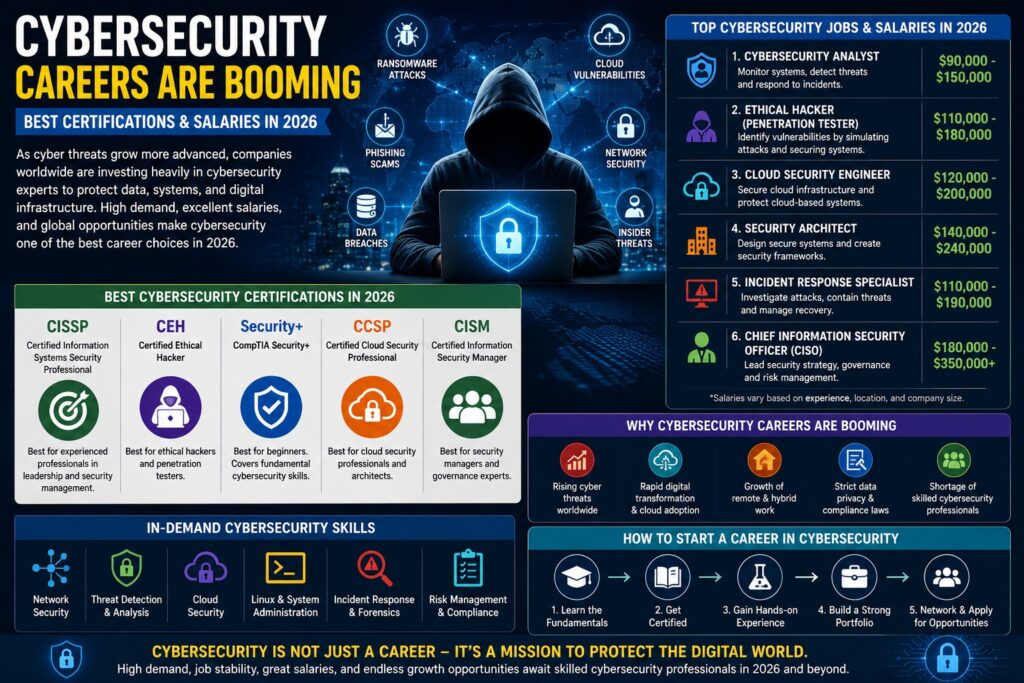
Cybersecurity has become one of the fastest-growing and highest-paying career fields in the world. In 2026, organizations across industries are investing heavily in digital security as cyber threats continue increasing in both frequency and complexity.
From ransomware attacks and data breaches to AI-powered cybercrime and cloud security risks, businesses are facing unprecedented challenges in protecting their systems, networks, and sensitive information. As a result, the demand for skilled cybersecurity professionals has reached record levels globally.
Companies are actively hiring cybersecurity experts to secure digital infrastructure, manage risk, and ensure compliance with evolving data protection regulations. At the same time, cybersecurity professionals are benefiting from excellent salaries, remote work opportunities, and strong long-term career stability.
In this article, we explore why cybersecurity careers are booming in 2026, the highest-paying cybersecurity roles, the best certifications to pursue, and how professionals can enter this rapidly growing industry.
Why Cybersecurity Careers Are Growing Rapidly
Several major trends are fueling the cybersecurity job boom worldwide.
1. Rising Cyber Threats
Cyberattacks are becoming more advanced every year. Businesses now face threats such as:
- Ransomware attacks
- Phishing scams
- Data breaches
- Cloud vulnerabilities
- AI-powered cybercrime
- Insider threats
Even small businesses are increasingly targeted by cybercriminals, making cybersecurity a top priority for organizations of all sizes.
2. Digital Transformation
Companies are rapidly adopting:
- Cloud computing
- Remote work infrastructure
- AI-powered systems
- Internet of Things (IoT) devices
- Digital payment platforms
While these technologies improve efficiency, they also create new security risks that require skilled professionals to manage and protect.
3. Remote and Hybrid Work
Remote work has significantly expanded corporate attack surfaces. Employees now access company systems from multiple devices and locations, increasing security vulnerabilities.
Organizations need cybersecurity specialists to secure:
- Remote networks
- Cloud applications
- Collaboration platforms
- Employee devices
Cybersecurity is now essential for modern remote-first businesses.
4. Global Data Privacy Regulations
Governments worldwide are introducing stricter data protection and compliance regulations.
Businesses must comply with laws related to:
- Data privacy
- Customer protection
- Cybersecurity reporting
- AI governance
Failure to meet compliance standards can lead to heavy financial penalties and reputational damage.
Cybersecurity professionals help organizations manage these regulatory requirements effectively.
Highest-Paying Cybersecurity Careers in 2026
Cybersecurity offers a wide range of high-income career paths.
1. Cybersecurity Analyst
Cybersecurity Analysts monitor networks, identify threats, and respond to security incidents.
Responsibilities:
- Threat detection
- Security monitoring
- Incident response
- Vulnerability assessment
Average Salary:
$90,000 – $150,000 annually
This is one of the most common entry points into cybersecurity careers.
2. Ethical Hacker (Penetration Tester)
Ethical Hackers simulate cyberattacks to identify weaknesses before criminals exploit them.
Responsibilities:
- Penetration testing
- Security audits
- Vulnerability scanning
- Risk analysis
Average Salary:
$110,000 – $180,000 annually
Ethical hacking remains one of the most exciting and highly paid cybersecurity specialties.
3. Cloud Security Engineer
As businesses move operations to cloud platforms, Cloud Security Engineers are becoming extremely valuable.
Responsibilities:
- Secure cloud infrastructure
- Monitor cloud environments
- Prevent unauthorized access
Average Salary:
$120,000 – $200,000 annually
Cloud security expertise is among the most in-demand technical skills in 2026.
4. Security Architect
Security Architects design secure enterprise systems and cybersecurity frameworks.
Responsibilities:
- Infrastructure planning
- Security strategy
- Risk management
- Security architecture design
Average Salary:
$140,000 – $240,000 annually
This role requires advanced experience and technical expertise.
5. Incident Response Specialist
Incident Response Specialists investigate and contain cyberattacks.
Responsibilities:
- Threat investigation
- Malware analysis
- Breach response
- Recovery planning
Average Salary:
$110,000 – $190,000 annually
Rapid response capabilities are critical in modern cybersecurity operations.
6. Chief Information Security Officer (CISO)
The CISO is a senior executive responsible for enterprise-wide cybersecurity strategy.
Responsibilities:
- Security leadership
- Risk governance
- Compliance oversight
- Security policy development
Average Salary:
$180,000 – $350,000+ annually
CISOs are among the highest-paid technology executives worldwide.
Best Cybersecurity Certifications in 2026
Cybersecurity certifications help professionals validate skills, improve job opportunities, and increase salary potential.
1. Certified Information Systems Security Professional (CISSP)
The CISSP remains one of the most respected cybersecurity certifications globally.
Best For:
- Security managers
- Security architects
- Experienced professionals
Focus Areas:
- Risk management
- Security operations
- Architecture
- Governance
This certification is highly valued by enterprise employers.
2. Certified Ethical Hacker (CEH)
The CEH certification focuses on penetration testing and offensive security.
Best For:
- Ethical hackers
- Penetration testers
- Security analysts
Skills Covered:
- Vulnerability testing
- Network security
- Ethical hacking techniques
CEH remains popular among aspiring cybersecurity professionals.
3. CompTIA Security+
Security+ is considered one of the best entry-level cybersecurity certifications.
Best For:
- Beginners
- IT professionals entering cybersecurity
Topics Covered:
- Threat management
- Risk analysis
- Network security
- Compliance basics
It provides a strong foundation for cybersecurity careers.
4. Certified Cloud Security Professional (CCSP)
Cloud security expertise is increasingly important in modern organizations.
Best For:
- Cloud engineers
- Security architects
- Cloud administrators
Focus Areas:
- Cloud security
- Data protection
- Cloud governance
Cloud-focused certifications are becoming extremely valuable.
5. Certified Information Security Manager (CISM)
CISM focuses on cybersecurity leadership and governance.
Best For:
- Security managers
- Leadership roles
- Risk management professionals
This certification is highly respected in enterprise environments.
Skills Needed for Cybersecurity Careers
Successful cybersecurity professionals require both technical and analytical skills.
Important skills include:
- Network security
- Threat detection
- Cloud security
- Risk management
- Linux and operating systems
- Incident response
- Ethical hacking
- Communication and problem-solving
Cybersecurity professionals must also stay updated as threats evolve constantly.
Industries Hiring Cybersecurity Professionals
Cybersecurity demand spans nearly every major industry.
Technology
Software companies and cloud providers require advanced security expertise.
Banking and Finance
Financial institutions face constant cyber threats and regulatory pressure.
Healthcare
Healthcare organizations protect highly sensitive patient data.
Government
Governments require cybersecurity professionals for national security and infrastructure protection.
Retail and E-Commerce
Online businesses need strong payment security and fraud prevention systems.
As digital systems continue expanding, cybersecurity talent shortages are expected to grow further.
Remote Cybersecurity Jobs Are Expanding
Cybersecurity is one of the best career fields for remote work opportunities.
Many companies now hire remote professionals for roles such as:
- Security monitoring
- Penetration testing
- Cloud security
- Threat analysis
- Compliance management
Remote cybersecurity jobs provide:
- Flexible work environments
- Global career opportunities
- Competitive salaries
This trend is expected to continue through 2030 and beyond.
How to Start a Career in Cybersecurity
Professionals interested in cybersecurity should focus on building practical skills and certifications.
Recommended steps include:
- Learn networking fundamentals
- Study cybersecurity basics
- Earn entry-level certifications
- Practice using cybersecurity labs
- Build hands-on experience
- Stay updated on evolving threats
Many successful cybersecurity experts begin with self-learning, online courses, and practical experimentation.
The Future of Cybersecurity Careers
Cybersecurity is expected to remain one of the most stable and high-growth industries over the next decade.
The rise of:
- Artificial Intelligence
- Cloud computing
- Remote work
- Digital infrastructure
- AI-powered cybercrime
will continue increasing demand for security professionals worldwide.
Businesses can no longer afford weak cybersecurity defenses, making skilled professionals essential for long-term digital success.
Conclusion
Cybersecurity careers are booming in 2026 as organizations worldwide battle increasingly sophisticated cyber threats and expand digital operations.
From ethical hacking and cloud security to executive leadership roles like CISO, cybersecurity offers exceptional salary potential, job stability, and career growth opportunities.
Professionals who invest in cybersecurity certifications, technical expertise, and continuous learning will remain highly valuable in the evolving digital economy.
As technology continues advancing, cybersecurity is no longer just an IT function — it has become one of the most important business priorities of the modern era.