Artificial Intelligence is no longer just a technology trend — it has become a core business strategy. In 2026, companies across industries are rapidly integrating AI into operations, customer service, marketing, cybersecurity, finance, human resources, and decision-making processes. As AI adoption accelerates globally, organizations are facing a new challenge: managing AI responsibly, strategically, and efficiently.
To address this growing complexity, businesses are increasingly creating a new executive leadership role — the Chief AI Officer (CAIO).
The rise of the CAIO reflects how important Artificial Intelligence has become in modern corporate environments. Companies are no longer experimenting with AI on a small scale; they are building entire business models around intelligent technologies. As a result, organizations need experienced leaders who can guide AI transformation while balancing innovation, ethics, compliance, and business growth.
In this article, we explore why companies are hiring Chief AI Officers in 2026, the responsibilities of the role, and why CAIOs are becoming essential in the future of business leadership.
What Is a Chief AI Officer (CAIO)?
A Chief AI Officer is a senior executive responsible for overseeing an organization’s Artificial Intelligence strategy, implementation, governance, and long-term AI vision.
The CAIO works closely with:
- CEOs
- CTOs
- CIOs
- Data science teams
- Cybersecurity departments
- Product and operations leaders
Their primary goal is to ensure AI technologies create business value while minimizing risks related to security, ethics, compliance, and operational efficiency.
In many organizations, the CAIO has become as important as traditional executive roles like Chief Technology Officer (CTO) or Chief Information Officer (CIO).
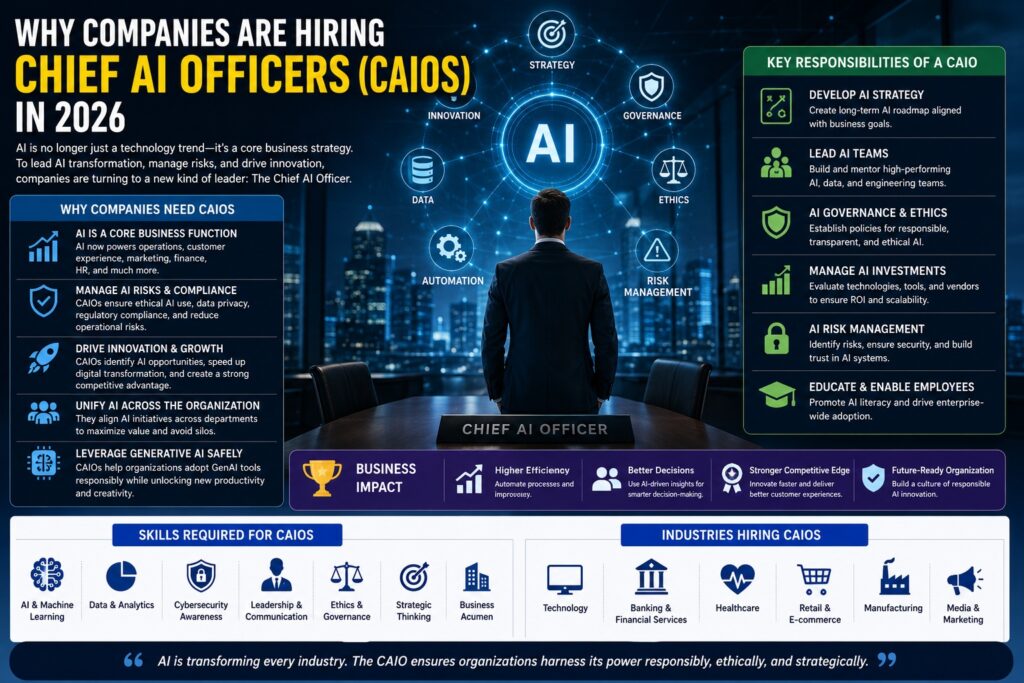
Why Companies Need CAIOs in 2026
1. AI Has Become a Core Business Function
In the past, AI projects were often handled by IT departments or innovation teams. However, AI is now deeply integrated into almost every area of business operations.
Companies use AI for:
- Customer support automation
- Predictive analytics
- AI-powered marketing
- Fraud detection
- Recruitment screening
- Supply chain optimization
- Financial forecasting
Because AI impacts multiple departments, businesses need a dedicated executive to coordinate enterprise-wide AI strategy.
The CAIO ensures AI initiatives align with overall business objectives instead of operating as isolated technology experiments.
2. Managing AI Risks and Compliance
One of the biggest reasons companies are hiring Chief AI Officers is the growing concern around AI governance and compliance.
AI systems can create serious risks, including:
- Data privacy violations
- Algorithmic bias
- Security vulnerabilities
- Legal liabilities
- Ethical concerns
- Misinformation
Governments worldwide are introducing stricter AI regulations, making responsible AI management a corporate priority.
CAIOs help organizations:
- Develop AI governance policies
- Ensure regulatory compliance
- Monitor ethical AI practices
- Reduce operational risks
As AI regulations become more complex, companies need leadership focused specifically on managing these challenges.
3. Driving AI Innovation and Competitive Advantage
Businesses are under intense pressure to innovate quickly in the AI-driven economy. Organizations that fail to adopt AI effectively risk falling behind competitors.
Chief AI Officers help companies:
- Identify AI opportunities
- Accelerate digital transformation
- Improve operational efficiency
- Create AI-powered products and services
- Increase productivity
CAIOs are often responsible for turning AI investments into measurable business outcomes.
Companies increasingly view AI leadership as a competitive advantage rather than simply a technical function.
4. Coordinating AI Across Departments
AI adoption often becomes fragmented within large organizations. Different departments may use separate AI tools, platforms, or workflows without proper coordination.
For example:
- Marketing teams may use generative AI for content
- HR departments may use AI recruitment tools
- Finance teams may deploy predictive analytics
- IT teams may implement automation systems
Without centralized leadership, AI strategies can become inconsistent and inefficient.
The CAIO helps unify AI initiatives across the organization while ensuring:
- Standardized AI practices
- Better collaboration
- Improved security
- Consistent governance
This coordination is becoming essential as enterprise AI ecosystems grow more complex.
5. Responding to the Rise of Generative AI
The explosive growth of generative AI tools has significantly increased demand for AI leadership.
Businesses are rapidly adopting AI systems for:
- Content creation
- Customer service
- Software development
- Internal automation
- Research assistance
However, generative AI also introduces challenges such as:
- Hallucinated information
- Copyright concerns
- Data leakage risks
- Quality control issues
Companies need executives who understand both the opportunities and limitations of modern AI systems.
CAIOs help organizations safely integrate generative AI into business operations while maintaining oversight and accountability.
Key Responsibilities of a Chief AI Officer
The role of a CAIO varies by organization, but common responsibilities include:
Developing AI Strategy
Creating long-term AI roadmaps aligned with business goals.
AI Governance and Ethics
Ensuring responsible and transparent AI usage.
Managing AI Teams
Leading data scientists, engineers, analysts, and AI specialists.
AI Risk Management
Monitoring cybersecurity, compliance, and operational risks.
Evaluating AI Investments
Assessing AI tools, vendors, and technologies.
AI Education and Training
Helping employees understand and adopt AI systems effectively.
Driving Innovation
Identifying new ways AI can improve products, services, and operations.
The CAIO often acts as the bridge between technical AI teams and executive leadership.
Industries Hiring CAIOs in 2026
The demand for Chief AI Officers is expanding rapidly across industries.
Technology Companies
Tech firms are leading AI innovation and require advanced AI leadership.
Financial Services
Banks and fintech companies use AI for fraud detection, analytics, and automation.
Healthcare
Hospitals and healthcare providers are adopting AI for diagnostics and patient care.
Retail and E-Commerce
Retailers use AI for personalization, inventory management, and customer insights.
Manufacturing
AI-powered automation and predictive maintenance are transforming production systems.
Media and Marketing
Generative AI is reshaping advertising, content creation, and audience targeting.
As AI becomes universal, CAIO roles are expected to grow across nearly every industry.
Skills Required to Become a Chief AI Officer
Successful CAIOs require a combination of technical knowledge, business understanding, and leadership abilities.
Important skills include:
- Artificial Intelligence expertise
- Data analytics
- Cybersecurity awareness
- Strategic planning
- Communication and leadership
- Ethical AI understanding
- Business operations knowledge
Many CAIOs also have backgrounds in:
- Data science
- Computer engineering
- Technology leadership
- Digital transformation
Strong leadership and decision-making skills are essential for executive AI management.
The Growing Importance of AI Leadership
The rise of Chief AI Officers reflects a larger shift happening in global business leadership.
In the past, technology leadership focused mainly on:
- IT infrastructure
- Software systems
- Digital operations
Today, AI is influencing:
- Business strategy
- Workforce productivity
- Customer experience
- Innovation
- Corporate competitiveness
This transformation requires dedicated executive oversight.
Many analysts believe CAIOs could become one of the most important C-suite positions over the next decade.
Challenges Facing CAIOs
Despite the opportunities, CAIOs also face major challenges, including:
- Rapidly evolving AI technologies
- Regulatory uncertainty
- Ethical concerns
- AI bias management
- Employee resistance to AI adoption
- Balancing automation with human workforce needs
Managing AI responsibly while driving innovation requires careful leadership and long-term strategic thinking.
Conclusion
In 2026, Artificial Intelligence is no longer just a technical initiative — it is a business priority shaping the future of global industries. As companies increasingly depend on AI systems for growth, efficiency, and innovation, the need for dedicated AI leadership has become critical.
Chief AI Officers are emerging as key decision-makers responsible for guiding organizations through the opportunities and risks of the AI era.
From AI governance and compliance to innovation and enterprise transformation, CAIOs play a central role in helping businesses remain competitive in a rapidly changing digital economy.
As AI adoption continues expanding worldwide, the Chief AI Officer may soon become one of the most influential executive roles in modern corporate leadership.